Our goal is “to prepare competent entry-level Paramedics in the cognitive (knowledge), psychomotor (skills), and affective (behavior) learning domains with or without exit points at the Advanced Emergency Medical Technician and/or Emergency Medical Technician, and/or Emergency Medical Responder levels.”
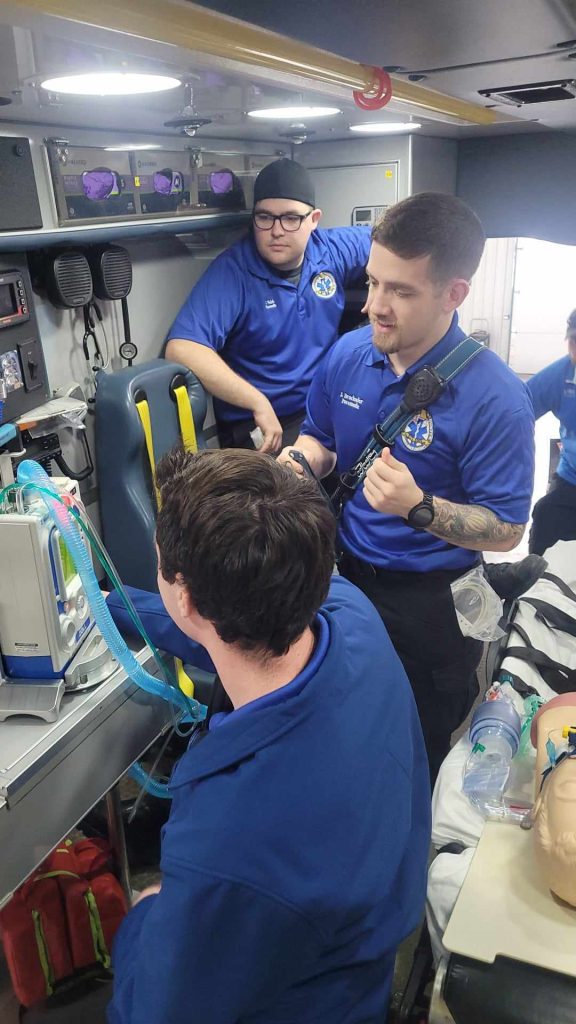
How do I become a medic and what does it take?
requirements
- You must be a EMT basic to enroll.
- Students do not have to have previous experience, but it is highly recommended.
- Students will be required to meet with the program director prior to the start of class to be sure they are committed to the rigorous program.
- Students should plan on the program taking about 14 months.
- The course requires an EMT Basic exam to evaluate student's knowledge upon entering the program.
- Students are expected to complete 400 hours of hospital clinicals and 400 hours of field clinicals during the program, as well as pass the classroom portion of the class.
Paramedic Clinicals
Clinical experience is required in multiple areas, including the Emergency Department, ICU, Labor and Delivery, OR, psych, and pediatrics. We provide a number of clinical sites throughout the region so students have multiple opportunities to learn in different settings. Students should expect to start clinical shifts after about 4-5 months into the program. Students must start clinicals early and maintain an aggressive approach to complete them on time.
Clinical Hours
JCAD’s paramedic program requires 400 hours of clinical time and 400 hours of field time. In addition, JCAD follows CoAEMSP and NREMT guidelines. Students are required to meet certain competency levels on individual skills, even if they have hit their minimum hours. Clinical hours and field shifts may be extended based on the need for a certain skill or on the student’s ability to function as a competent paramedic.
Field Internship
Paramedic Program
Exam, Rention, & Placement by year
| Graduating Year | # of Students | # Completed | Retention | +Placement | NREMT Overall |
|---|---|---|---|---|---|
|
2020 (na) |
|
|
(No graduates during the 2020 reporting year) |
– |
– |
|
2021 (na) |
|
|
(No graduates during the 2021 reporting year) |
– |
– |
|
2022 |
20 |
18 |
90% |
100% |
100% |
|
2023 |
22 |
21 |
95% |
100% |
90% |
|
2024 |
49 |
41 |
94% |
100% |
95% |
|
2025 |
50 |
50 |
100% |
100% |
90% |
**Retention rate indicates students who have completed more than ten percent of the overall program and dropped the course.**
COAEMsP Accreditation
The Johnson County Ambulance District Paramedic program is accredited by the Commission on Accreditation of Allied Health Education Programs (www.caahep.org) upon the recommendation of the Committee on Accreditation of Educational Programs for the Emergency Medical Services Professions (CoAEMSP).
Commission on Accreditation of Allied Health Education Programs
To contact CAAHEP:
Commission on Accreditation of Allied Health Education Programs
(727) 210-2350
www.caahep.org
To contact CoAEMSP:
(214) 703-8445
www.coaemsp.org
Phone
660-747-5735 ext 3
education@jocoamb.com
Office Hours
8am-4pm
Come See Us
500 E. Young Avenue
Warrensburg, MO 64093